


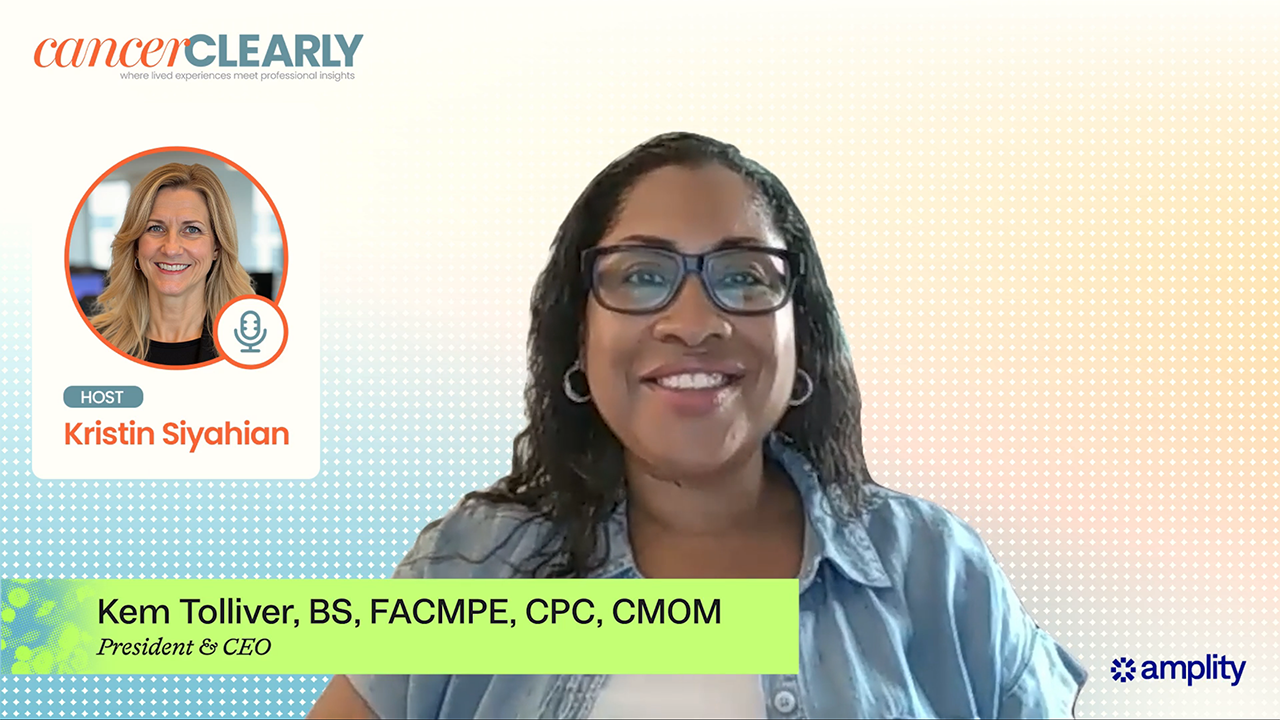
 In this episode, we sit down with Kem Tolliver, President and CEO of Medical Revenue Cycle Specialists and a nationally recognized expert in practice management and revenue cycle optimization, to unpack why oncology’s financial infrastructure is uniquely complex and why getting it right directly impacts patient access and outcomes. From denial prevention to workflow redesign, Kem shares actionable insights every oncology leader should hear.
Transcript
Welcome to Cancer, Clearly, a podcast about the cancer experience told from every angle.
Kristin: I’m your host, Kristin Siyahian, and today I’m thrilled to welcome Kem Tolliver, President and CEO of Medical Revenue Cycle Specialists, author, podcaster, and one of the most respected voices in medical practice operations and revenue cycle strategy.
Oncology practices operate within one of the most complex financial ecosystems in healthcare. Kem has spent her career helping organizations strengthen their operational infrastructure so patients can access the care they need without administrative barriers.
Why Oncology Revenue Cycle Management Is Uniquely Complex
Kristin: Oncology practices deal with some of the most complex and costly treatments in medicine. Why is strong revenue cycle management especially critical in oncology?
Kem: Oncology is unique — clinically and financially. Cancer care involves multiple modalities: chemotherapy, immunotherapy, radiation, surgery, genetic testing, supportive therapies, and long‑term monitoring. All of this happens across multiple settings and over extended periods of time.
On top of that, oncology drugs and biologics are extremely expensive. One authorization issue or one coding error can create significant financial risk for both the practice and the patient. So strong revenue cycle management isn’t just about getting claims paid — it’s about ensuring patients receive life‑saving care without delays.
That means verifying eligibility, coordinating benefits, securing prior authorizations, attaching documentation correctly, counseling patients on out‑of‑pocket costs, and capturing every service accurately. When these processes work together, providers can focus on treating patients instead of navigating reimbursement obstacles.
How Revenue Cycle Directly Impacts Patient Access and Outcomes
Kristin: You mentioned patient access. How does revenue cycle management directly affect a patient’s ability to start and stay on treatment?
Kem: Cancer doesn’t wait — and neither should treatment. Every administrative delay can impact outcomes and quality of life.
Strong front‑end processes are essential: insurance verification, benefit coordination, prior authorization management, and financial navigation. If we don’t know who’s primary or secondary, we can’t bill correctly. If we don’t secure authorizations, treatment gets delayed. If patients don’t understand their financial responsibility, they may hesitate to start care.
When practices invest in staff, workflow, technology, and patient support services, patient experience improves — and so does adherence to treatment plans. Ultimately, revenue cycle management is about preventing non‑payment and preventing interruptions in care.
Common Denials — and How to Prevent Them
Kristin: What are the most common denials you see in oncology, and how can practices proactively avoid them?
Kem: Prior authorization issues and down‑coding top the list.
To prevent them:
- Understand payer reimbursement guidelines.
- Maintain a matrix of services and medications requiring authorization.
- Document medical necessity thoroughly.
- Use specific diagnosis codes.
- Build templates that support complete documentation.
- Track drug‑specific billing requirements.
- Share payer policy updates internally — because payers rarely communicate them well.
And above all: be proactive. Don’t wait for denials. Investigate requirements upfront.
Where Technology Fits — and Where It Doesn’t
Kristin: You’re known for aligning technology with optimal workflows. How can oncology practices use technology to improve revenue cycle performance?
Kem: I love automation — but never automate a broken workflow.
For example, I worked with an FQHC paying 18% of collections to verify Medicaid eligibility. The real issue? Their clearinghouse wasn’t enrolled with Medicaid. Fixing that solved the problem without outsourcing.
Technology can help tremendously:
- Automated eligibility verification
- Tools that identify prior authorization requirements
- Systems that analyze progress notes for missing documentation
- Predictive analytics for value‑based care
- Rule engines that scrub claims before submission
But technology should enhance a solid workflow, not mask a broken one.
Kem’s Career Journey and Leadership Philosophy
Kristin: Shifting gears — what inspired you to focus on revenue cycle management?
Kem: Early in my career, I saw dedicated clinicians struggling with operational challenges that limited their ability to serve patients. I realized that healthcare organizations can only fulfill their mission when they’re financially stable and their workforce is supported.
I became fascinated with the intersection of clinical excellence, operational efficiency, and financial sustainability. Over time, I came to see revenue cycle not as billing, but as a strategic function.
One lesson I’ve learned: effective leadership is about credibility, passion, and inspiring your team.
The Value of the CMOM Credential in Oncology
Kristin: You hold many credentials, but I’m curious about the CMOM — Certified Medical Office Manager. Why is it valuable, especially in oncology?
Kem: CMOM was my first credential, and it’s still incredibly relevant. It represents expertise in revenue cycle, compliance, HR, financial oversight, patient experience, operations, and value‑based care.
Oncology leaders must balance clinical priorities, regulatory requirements, workforce challenges, and financial performance. CMOM provides the foundation to lead strategically and proactively.
What’s Next for Oncology Revenue Cycle Management
Kristin: Looking ahead, how do you see revenue cycle evolving in oncology over the next three to five years?
Kem: We’re entering a data‑driven era. The practices with the best data will have the best outcomes.
Key areas:
- Authorization approval rates
- Denial trends
- Days in A/R
- Cost‑to‑care analytics
- Break‑even analysis
- Technology adoption
Value‑based care will continue expanding. Success will depend on quality outcomes, care coordination, patient engagement, cost efficiency, and technology integration.
And CMS is pushing us there — the 2026 Final Rule includes a –2.5% efficiency adjustment to practice RVUs, essentially saying: “Technology exists. Use it.”
Advanced therapies, genetic testing, and biomarker‑driven care will require stronger payer engagement and deeper financial understanding.
Access to care initiatives will be essential.
Where to Find Kem Tolliver
Kem can be reached at:
- Medical Revenue Cycle Specialists: medrevenuecycle.com
- Practice Management Institute (PMI): pmimd.com
- LinkedIn: Kem Tolliver